8 Years After Woolsey, Malibu Finally Has a Wildfire Siren
Malibu’s long-coveted wildfire siren has arrived. Now, the city has to figure out how to test it.
Holly Bieler · September 15, 2026
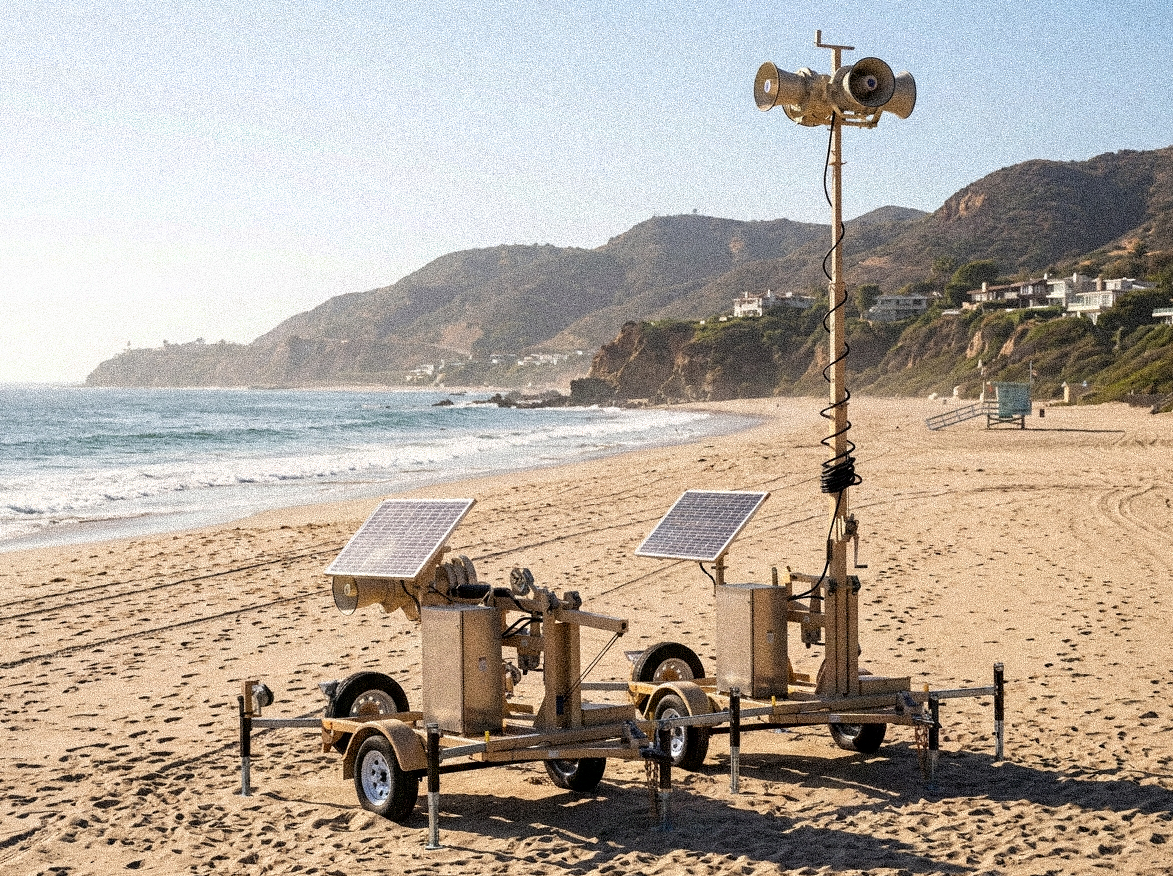
After an eight-year battle, Malibu finally has a fire siren.
It’s been a long road. After Woolsey, the city hired a consultant, whose 2020 report proposed 22 fixed sirens for $1.2 million to $1.9 million, and won a FEMA grant to help pay.
The plan stalled almost immediately. Commissioners doubted anyone indoors or in a Santa Ana wind would hear them, and a planning commissioner warned that each pole would cost about $30,000 and need its own environmental review. A 2023 redesign by the manufacturer grew to [32 sirens at about $2 million](https://malibutimes.com/wildfire-warning-sirens-could-be-coming-to-malibu-later-this-year) and went nowhere either.
Then came the Franklin and Palisades fires, during which power shutoffs again crippled Malibu's Everbridge alert system, an [after-action report](https://www.smdp.com/malibu-reviews-wildfire-response-outlines-fixes-after-devastating-2024-25-fire-season/) found this spring. Last summer the city arranged to take two surplus siren trailers off Los Angeles' hands, [promising a public demonstration](https://www.canyon-news.com/malibu-receives-mobile-emergency-siren-trailers/) in the fall. It took a year for the first one to arrive.
The trailers carry high-powered speakers on a mast that can blast a siren tone or a recorded voice message across a neighborhood, the way tornado sirens do in the Midwest. The city plans to park them in fire-prone areas on red flag days as a backup when phones go dark.
How far they will carry is the open question: the manufacturer publishes no range, its coverage estimates assume flat terrain and calm air, and Public Safety Director Susan Dueñas told the Public Safety Commission that in Malibu's canyons, nobody knows how far the sound will travel until they test it.
Which leaves Malibu facing a unique problem: how to test if something can scare people awake, without scaring people awake?
"You don't want people to panic," Dueñas said. "Or generate a thousand phone calls to City Hall."
The likely approach will be to pick one Malibu neighborhood to test it in, she said, and send a mailer out beforehand. Malibu Park and Malibu West were both mentioned as test sites. Which doesn't exactly sound like an honor.
"The test has to be, can you wake everybody up," Councilmember Doug Stewart said [in April](https://www.smdp.com/malibu-reviews-wildfire-response-outlines-fixes-after-devastating-2024-25-fire-season/).
The answer will be revealed in a survey sent to residents in the days after the siren, asking whether it woke them up or not.
A second test will take place during a high-wind event, Dueñas said, but in a different area. Zuma Beach was mentioned as a possibility.
But as of now, Dueñas said, no tests are scheduled.
The sirens are part of a broad investment by Malibu in the years after Woolsey, into ways of reaching residents when the grid fails. The city hasn’t shied away from approaching the problem creatively. In recent years, the city has installed a booster antenna that extends local radio station KBUU's signal to about [85 percent of the coastline](https://malibutimes.com/still-in-recovery-malibu-steps-up-safety-efforts-as-fire-season-approaches), awarded a [$100,000 grant](https://www.smdp.com/malibu-awards-415-000-in-grants-for-education-wildfire-preparedness/) to the volunteer Community Brigade, and appears to be in talks to install a [$950,000 AlertFM radio-alert system](https://smdp.com/government-politics-2/malibu-explores-emergency-alert-systems-after-recent-disasters-expose-communication-gaps/).
The wildfire sirens have played an important part in the city’s new alert system plan. It’s still a relatively rare system, though other fire towns that have tried the sirens have had mixed results.
Paradise, which lost 85 people in the 2018 Camp Fire, built [21 siren towers](https://www.paradiseca.gov/recovery/page/how-emergency-warning-system-works) for about $3 million. At the first test, a reporter found [only two of nine businesses](https://www.mynspr.org/news/2023-06-15/sirens-or-silence-paradises-first-test-of-its-early-warning-system-shows-mixed-results) along the main road heard it, and the mayor later said he [couldn't hear it well](https://laist.com/news/climate-environment/cellphone-emergency-alerts-can-sirens-help-during-next-big-fire) inside his own house a quarter mile away. When the town sounded them for a real fire this July, [residents complained](https://krcrtv.com/news/local/paradise-emergency-siren-procedures-under-review-after-dudley-lane-wildfire) the sirens came only after the evacuation order had gone out.
There is a reason the research is thin. The National Weather Service says outdoor sirens are ["designed only to alert those who are outside,"](https://www.weather.gov/dvn/sirenFAQ) and the people who study warnings say a siren alone rarely moves anyone. People [look for confirmation](https://nvlpubs.nist.gov/nistpubs/TechnicalNotes/NIST.TN.1950.pdf) before they act, the study said.